
Prevent Revenue Loss from Missed Business Calls
Revenue Leakage, Missed Calls, Lead Recovery
Why 90% of Missed Calls Never Call Back (And What Your Business Can Do About It)
As a quantitative trader, I’m trained to track where money leaks out of a system. In small and mid-sized businesses, one of the biggest leaks is simple: missed calls that never come back.
90% of missed calls never come back
Across multiple 2026 studies, 60–80% of inbound calls to small businesses go unanswered. RingReady reports that up to 85% of those callers hang up without leaving a voicemail and move on to the next option in search results (RingReady, 2026). Clockwork finds that 81% of missed callers immediately call the next business they see (Clockwork, 2026). Put simply, about 9 out of 10 missed calls are gone for good.
In trading, if you ignore 90% of incoming orders, you go out of business. Yet many local businesses run their phone lines exactly like that.
Why callers don’t call back: they just go to your competitor
Most callers are not “shopping around for fun.” They have a problem right now. A burst pipe. A dead AC. A sore tooth. A last‑minute catering need. They type into Google, tap the first few results, and work down the list until someone answers or responds fast.
If you don’t answer, 72–85% do not leave a voicemail.
Over 80% call the next business in the list instead.
They are not mad at you. They are in a hurry. The market punishes slowness. That’s as true in home services as it is in financial markets.
What a single missed call really costs: a simple example
Let’s run the numbers on a realistic small service business: a local HVAC company.
Metric Assumption Average job value $350 per service call Conversion when answered live 40% (in line with 41% benchmark) Conversion when call is missed & called back later 6% (Clockwork benchmark)
If you answer live, every inbound call is worth: $350 × 40% = $140 expected revenue. If you miss the call and try to chase it later: $350 × 6% = $21 expected revenue.
The gap is $119 per missed call. That’s the “opportunity cost” of not engaging in real time. If you miss just 3 calls a day, five days a week:
3 missed calls × $119 × 5 days × 50 weeks ≈ $89,250 per year.
That lines up with industry estimates of $78,000–$126,000 lost annually from missed calls for small service businesses. This is not a “soft” number. It’s as real as payroll or rent.
The critical first 5 minutes after a missed call
In trading, we watch what happens in the first seconds after news hits. That window decides who wins the trade. Your phone line has a similar “price discovery” window: the first 5 minutes after a missed call.
Minute 0–1: Caller hits voicemail. They hang up. No message.
Minute 1–2: They tap back to Google Maps or search results.
Minute 2–4: They call the next business. If that one answers or texts back, the job is gone.
Minute 4–5: By the time you notice the missed call, they’re already booked with someone else.
📌 Key Takeaway: If you don’t engage within 5 minutes, you are usually too late. The lead has “traded” to a competitor.
Missed call text-back automation: turning leaks into leads
You can’t answer every call. You’re on a job site, in a client meeting, or closed for the night. But you can respond instantly. That’s where missed call text-back automation comes in. Think of it as an auto‑execution system for your phone leads.
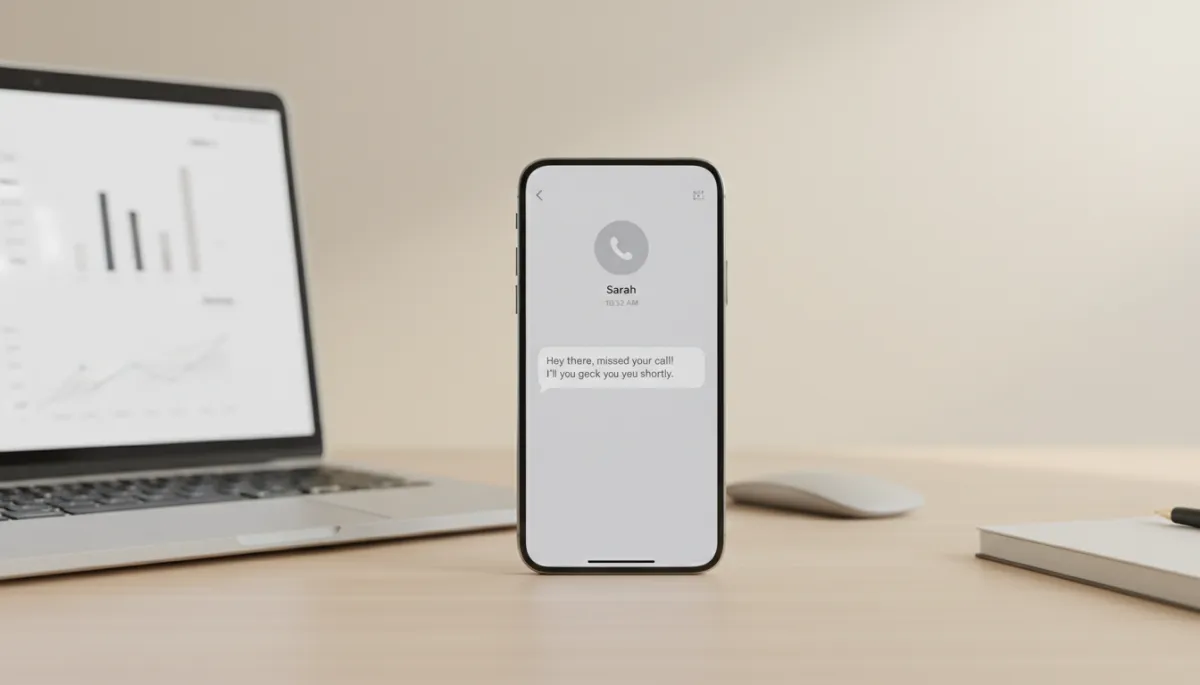
-toned close-up of a smartphone on a desk showing an incoming call that was missed and an...
Automated text back systems recover leads that would otherwise disappear in minutes.
Here is how a typical automated text back system works, in plain terms:
A call comes into your main business number.
If you answer, nothing changes. Business as usual.
If you miss the call, the system detects it within seconds.
It sends a pre‑written text from your business number, for example: “Hi, this is Apex HVAC. Sorry we missed your call. Reply with what you need and we’ll confirm a time.”
The caller replies by text. The conversation continues by SMS or you call them back with context in hand.
💡 Pro Tip: Treat missed call text-back as your “market‑making bot” for small business leads. It always shows up, even when you can’t.
Real‑world impact: from random leaks to predictable lead recovery
One of my clients, a 7‑truck plumbing company, looked solid on the surface. Good reviews. Steady work. But when we pulled the call logs, they were missing about 40% of inbound calls, especially during lunch, evenings, and weekends.
We installed a missed call text-back system and tracked it like a trading strategy for 90 days. Here’s what we saw:
Average of 11 missed calls per weekday, 7 on weekends.
78% of missed callers received and opened the automated text.
46% replied by text with details (“clogged drain,” “water heater leaking,” etc.).
Of those who replied, about 35% booked a job.
The net effect: they recovered roughly 3–4 extra jobs per day that would have been pure loss. At an average ticket of $280, that’s around: $280 × 3.5 × 22 workdays ≈ $21,560 per month in recovered revenue. The system cost them less than a part‑time receptionist.
From a financial analyst’s view, this is a very simple trade: small fixed cost for automation, in exchange for a large, repeatable stream of recovered cash flow. That’s exactly what you want from any system: asymmetric payoff.
Treat missed calls like a trading strategy, not an accident
In markets, we define the rules: entry, exit, and risk per trade. You can do the same with your phone line:
Entry: Any missed call during business hours or after hours.
First action (within 10–30 seconds): automated text back asking what they need and offering a simple next step (quote, booking link, or “send a photo”).
Follow‑up: You or your team reply when free, but the lead is already “in play” and less likely to defect to a competitor.
That simple framework turns random missed calls business into a controlled lead recovery process. You’re no longer hoping people call back. You’re capturing them in real time, with a system that never gets tired or distracted.
Next step: get a clear view of your leak and fix it
If you’re running a small or mid-sized business, you don’t need more theory. You need numbers and a plan. I help owners audit their inbound calls, quantify the revenue they’re leaking, and set up missed call text-back systems that pay for themselves fast.
If you want to see what this looks like for your business—your call volume, your average job size, your potential upside—book a free digital audit. We’ll:
Pull basic call and lead data (or estimate it if you don’t have tracking yet).
Quantify your current missed call loss in dollars per month and per year.
Design a simple automated text back flow to plug the leak within days, not months.
CTA: Stop letting competitors “front‑run” your phone leads. Book your free digital audit today and turn missed calls into booked revenue instead of silent losses.
SEO_TITLE: Why 90% of Missed Calls Never Call Back (And How Text-Back Automation Recovers Small Business Leads)
SEO_DESCRIPTION: Learn why 90% of missed calls never return, what each missed call costs your small business, and how missed call text-back automation can recover lost leads and revenue in minutes.
SEO_KEYWORDS: missed call text-back, missed calls business, small business leads, lead recovery, automated text back
